
June 2, 2026 / 14 min read
SEO-GEO News
Google 2026 Endgame: Consumer search behaviour has structurally changed, Google owns data proves it.

Author: Marco Cirillo, Senior SEO & GEO Manager

You know search is changing. You've seen it yourself.
You’ve seen the AI overviews. You’ve watched click-through rates drop on pages that used to drive leads. You’ve read about AEO and GEO and every acronym that came after.
But there’s a gap between knowing search is changing and knowing what to actually do about it.
Google closed part of that gap the same week as I/O 2026. They published a year of real AI Mode usage data, behavior patterns from a billion users, not projections. Alongside it, an independent study from Peec AI analyzed 500,000 prompts and quantified exactly how dominant AI-generated answers have become in Google Search.
This article goes through both datasets, adds the I/O 2026 product announcements that actually affect content strategy, and tells you what the combination means for how you should be building, structuring, and measuring content right now.
The Scale Problem: AI Overviews Appear in 86% of Searches
Before any strategy discussion, it helps to understand the actual scope of what’s happened.
A year ago, AI Overviews were still mostly associated with informational queries — how-tos, definitions, explainers. The assumption in most SEO circles was that commercial intent queries were largely safe from AI answer displacement.
That assumption is now wrong.
Peec AI analyzed 500,000 business-oriented prompts, the kind of queries brands monitor to track category visibility, product comparisons, and decision-stage searches. Their finding: AI Overviews appeared in 86% of those prompts. (Peec AI, June 2026)
Twelve months earlier, that number was 57%. That’s a 50% increase in a year.
For decision-stage, bottom-of-funnel queries specifically, AI Overviews appeared 88.5% of the time — slightly higher than the 86% average. The idea that AI answers are reserved for informational queries and that commercial intent is safe is not supported by the data.
At the same time, Google confirmed at I/O 2026 that AI Mode has crossed 1 billion monthly active users globally, with query volume doubling every quarter since launch. (Google, year-one AI Mode insights) With 2.5 billion monthly users confirmed for AI Overviews at I/O, Google’s AI search surfaces are the largest in the world — larger than ChatGPT, Claude, and Perplexity combined.
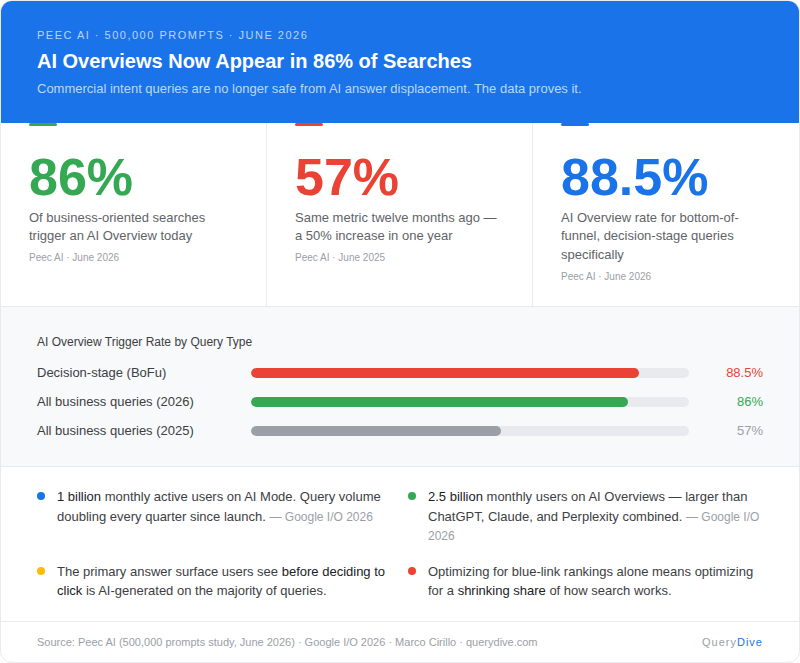
The practical implication is direct: optimizing only for blue-link rankings is optimizing for a shrinking share of how search actually works. The primary answer surface, the thing users see before they decide whether to click anything, is AI-generated, and it appears on the majority of the queries your ICP is running.
The Query Length Shift: 3x Longer, and Growing
The single most strategically important number in Google’s year-one AI Mode report is this: the average AI Mode query is three times longer than a traditional search query.
This is a structural change in query intent.
People aren’t typing “best CRM software” into AI Mode. They’re asking “what’s the best CRM for a B2B SaaS company with a 10-person sales team that needs Salesforce-level reporting but doesn’t want the implementation cost.” That query carries context, constraints, company stage, and a specific trade-off. It’s a decision request, not an information request.
A page optimized around the keyword “best CRM software” doesn’t answer that question. It doesn’t have the right specificity. A page built around use case clusters, decision frameworks, and comparison structures - one that maps specific reader contexts to specific outcomes - does.
This is where most content briefs built before 2026 are misaligned. Short-tail keyword targeting still has a role, particularly for navigational and brand queries. But it’s no longer the spine of a content strategy for AI search environments. Conversational, multi-clause queries are where the volume is concentrated and growing.
Reinforcing this: decision questions starting with “which” increased 40% in AI Mode, with “which of” and “which one” growing fastest. (Search Engine Journal) Follow-up queries within the same AI Mode session rose over 40% monthly in the U.S. Users aren’t doing single searches anymore. They’re having conversations with the search interface, iterating, refining, comparing.
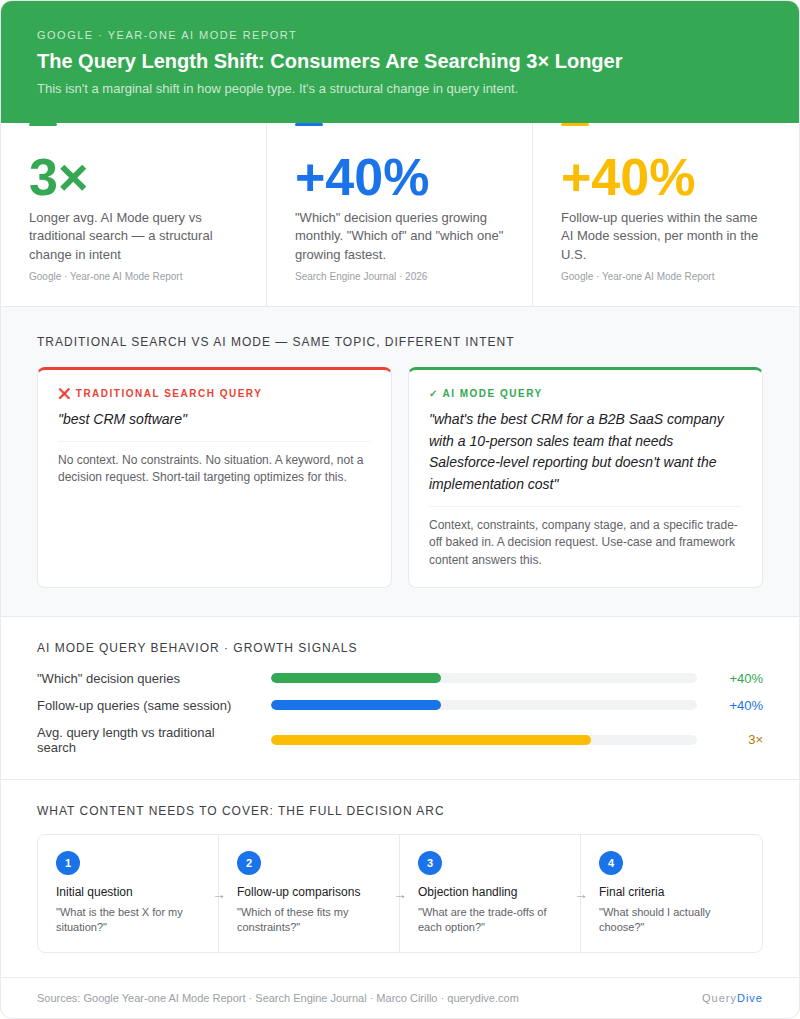
Content structured for a single keyword query doesn’t serve that behavior. Content structured for the full arc of a decision, the initial question, the follow-up comparisons, the objection handling, the final criteria, does.
The Intent Shift: Planning and Decision Queries Are Outpacing Everything Else
Longer queries are part of the picture. The intent behind those queries tells you what content to build.
Google’s data shows planning queries grew 80% faster than overall AI Mode query growth in the past six months. Brainstorming queries grew 30% faster than queries overall since launch. The fastest-growing patterns were “where to,” “where should I,” and “ideas for.” (Google, year-one AI Mode insights)
There’s a clean distinction here that matters for content strategy.
Informational content answers “what is X.” Decision-support content answers “which X should I choose given my situation.” Informational content explains. Decision-support content helps the reader act.
The data is telling you that the second category is growing faster than the first. A content audit using this lens is worth running on any site before the next quarter’s planning cycle. The question for each piece: does this help someone understand, or does it help someone decide?
Frameworks, comparison guides, structured trade-off analyses, and content that maps a specific reader context to a specific recommendation all fall into the decision-support category. These are the content types AI Mode is increasingly being asked to surface, which means they’re the content types most likely to earn citations in AI-generated answers.
The Multimodal Layer: 1 in 6 Searches Now Uses Voice or Images
More than one in six AI Mode queries are now non-text. Image-input searches have grown over 40% month-over-month since launch. Image creation queries have more than tripled since early 2026. (Google, year-one AI Mode insights)
This matters for content strategy in a way that’s easy to underestimate.
A content strategy without a visual layer, original diagrams, annotated screenshots, process illustrations, descriptive alt text, is invisible to a growing share of queries. Visual content isn’t a design enhancement anymore. It’s a retrieval channel.
Original visuals do two jobs. For human readers, they make complex ideas faster to understand. For AI retrieval systems operating in a multimodal environment, they provide an additional surface for the content to be discovered and referenced. A well-annotated diagram of a content framework is both useful to a reader and indexable in ways that a paragraph describing the same framework is not.
This applies particularly to technical and process content. If your content explains how a system works, an original diagram is now a content asset, not a nice-to-have.
The Zero-Click Reality: Traffic and Visibility Are No Longer the Same Metric
This is the part of the AI search transition that most reporting understates.
Ahrefs data from February 2026 shows AI Overviews reducing top-ranking click-through rates by 58%, nearly double the 34.5% reduction measured eight months earlier. (PikaSEO) According to Semrush data, 93% of searches in AI Mode end without a click to an external site.
The zero-click rate across all Google searches is now 64.82%, up from 58.5% two years ago. (Digital Applied)
These numbers are real. But there are two things the headline figures miss.
First, the clicks that survive are higher quality. When AI Overviews appear and a user still clicks through, that user has already read a summary and is seeking something more, they arrive with stronger intent. AI referral traffic converts measurably better than traditional search traffic on commercial queries.
Second, citations are a form of visibility even without a click. A brand that appears consistently in AI-generated answers builds recognition at the research stage of the buyer journey, before the user has decided they need anything. That’s awareness and authority compounding at the top of the funnel, even when no click happens.
This is why citation share is the metric that replaces rank tracking as the primary signal for AI search performance. Rank tells you where you sit in blue-link results. It says nothing about whether your brand appears in the answer a user actually reads.
Google Preferred Sources: Brand Recognition Becomes a Retrieval Signal
The I/O 2026 announcement that most content teams haven’t registered yet: Preferred Sources is now live inside AI Overviews and AI Mode.
Users can designate which websites they trust in their Google settings. Those sites are then labeled and highlighted whenever they appear inside AI-generated answers. Google’s internal data shows users are twice as likely to click through to a Preferred Source. Over 345,000 unique sources have already been selected by users globally. (Google blog, May 27 2026)
Google is also expanding the “Highly Cited” badge across search results, a visible label marking original reporting and primary sources.
Here’s what this changes strategically.
The traditional SEO playbook assumes Google’s algorithms decide who earns visibility. Preferred Sources introduces a parallel path: your audience can directly pull you into AI answers. A user who has marked your site as a Preferred Source will see your content highlighted inside AI-generated results, regardless of where you rank against competitors for that specific query.
As one analysis put it: “AI visibility is no longer only about being mentioned or being cited. It’s about being chosen.” (Search Engine Journal)
For content teams, this has a concrete implication. Building an audience that knows your brand by name — through newsletter subscribers, repeat visitors, social followers — is no longer only a brand exercise. It’s a mechanism by which those users can pull your content into AI answers they receive. Brand-building and AEO are the same work, measured differently.
The Provenance Layer: What “Original Content” Means to a Machine in 2026
The most under-covered story from I/O 2026 week is the content provenance update.
On May 19, 2026, the same day as Google I/O, OpenAI announced it was joining the C2PA standard steering committee and integrating Google DeepMind’s SynthID watermark into images generated by ChatGPT and the OpenAI API. (OpenAI, May 2026) That same day, Google announced C2PA verification and SynthID detection are coming natively to Google Search and Chrome.
Two of the largest AI labs, on the same day, landed on the same answer about how to verify whether content is AI-generated.
Here’s what that means in plain terms.
SynthID is already embedded in over 100 billion images and videos. New adopters include OpenAI, ElevenLabs, Kakao, and Nvidia. Users can now ask AI Mode, Lens, and Circle to Search “Is this AI generated?” and receive an answer. (C2PA Viewer)
Author bios, dated original research, methodology disclosures, and properly sourced photography used to be trust signals to human readers. They’re becoming machine-readable provenance signal, structured metadata that AI retrieval systems can evaluate when deciding what to cite.
The question has shifted. It’s not “should we use AI to produce content?” That’s settled. AI-assisted production at some level is standard across almost every content team operating at scale. The question is: what layer of original human work, verified data, and documented expertise sits on top of it?
Content that carries verifiable provenance signals, original research with a named author, camera-captured imagery with proper sourcing, proprietary data attributed to first-party analysis, is in a different retrieval category than content that cannot demonstrate its origin. That distinction is being encoded into the infrastructure of search.
The Citation Overlap Problem: Google’s AI Surfaces Don’t Cite the Same Domains
There’s a fragmentation issue that doesn’t get enough attention in AI search strategy discussions.
Recent research covering 7 AI platforms found that only 11% of domains are cited by both ChatGPT and Perplexity. The citation overlap between AI Overviews and AI Mode is only 13.7%. (Mean CEO Research)
This means Google’s own AI products, AI Overviews and AI Mode, are citing different sources. A page that earns citations in AI Overviews is not automatically being cited in AI Mode. A brand visible on ChatGPT is not automatically visible on Perplexity.
For content strategy, this has two implications.
First, tracking AI visibility on one platform tells you nothing about the others. A measurement approach that checks only Google AI Overviews misses the AI Mode picture entirely, and both miss the ChatGPT and Perplexity picture. Citation share needs to be measured across platforms, not within one.
Second, the content attributes that earn citations differ by platform. AI Mode references far more unique domains than AI Overviews. Gemini favors different social and media sources. Treating all AI search surfaces as one channel produces weak execution because the optimization inputs aren’t the same.
What the Rank-to-Citation Migration Actually Looks Like
Google confirmed that Personal Intelligence is now expanding across nearly 200 countries and 98 languages in AI Mode, with no subscription required. Users can connect Gmail, Google Photos, and soon Google Calendar, so AI Mode personalizes results based on individual context. (Google I/O 2026)
The same query returns different answers for different users.
This is the structural reason why rank tracking is no longer sufficient as a primary metric. Rank tracking tells you where a URL sits in blue-link results for a simulated query, run by a tool, at a point in time. It tells you nothing about what a specific user, with their email history, their browsing context, their stated preferences, actually sees when they run that query in AI Mode.
The metric that fills this gap is citation share: how often your content appears as a cited source in AI-generated answers across a defined query set, sampled consistently over time. It’s the AEO equivalent of share of voice.
Building a citation share measurement system doesn’t require replacing your existing SEO reporting. It requires adding a parallel layer: a defined set of queries relevant to your ICP, run regularly across the AI search surfaces where they spend time, with systematic tracking of which sources appear. Tools like QueryDive decode these answers to identify the patterns and content signals that earn citations, making it possible to move from measurement to optimization.
What Hasn’t Changed and Why It Matters More Now
Three things are the same as before I/O 2026. They matter more now, not less.
E-E-A-T Still Feeds the Runtime
AI Mode still pulls from sources. Quality, expertise, and authority signals still influence what gets cited. The foundational SEO playbook hasn’t been invalidated, it’s being extended by a provenance layer and a brand recognition layer on top.
Content that would have done well in traditional SEO for the right reasons, genuine expertise, original perspective, credible sourcing, is better positioned in AI search than content that gamed keyword density. The criteria are stricter now, not different.
Structured Content Still Wins Retrieval
Clear headings, scannable sections, FAQ blocks, schema markup, and front-loaded answers are how AI systems chunk and cite content. These structural signals haven’t changed. They’ve become more important as the volume of queries processed by AI retrieval systems scales.
A useful test: can any single H2 section in your article stand alone as a useful answer if extracted out of context? If an AI system pulls just that passage, does it make sense? If not, the section needs rewriting. Passage-level clarity is the standard, not page-level coherence.
Original Data Is the Strongest Moat
AI systems can summarize the public internet. They cannot generate your proprietary case studies, your first-party survey data, or your documented experiments. Those assets signal human work in a content layer that’s increasingly synthetic, and they’re the hardest for competitors to replicate.
This is the highest-leverage investment available to content teams right now. Not more production volume. More original source material that only you have access to.
Wrapping all up…
Search behaviour has shifted.
The content strategy that worked in 2023 keyword-targeted articles, rank as the primary metric, text-only production, generic AI-assisted volume is losing citation share to content that matches how people actually search now: conversationally, with decision intent, across visual and text inputs, and with brand recognition as a sorting mechanism.
The teams that close the gap earliest will do it with the same fundamentals that have always driven organic visibility: genuine expertise, original research, and structured, readable content. What’s new is the measurement layer citation share as the headline metric, citation fragmentation as the tracking challenge, and provenance as the trust signal that AI retrieval systems are increasingly weighing.
The next step is a citation share audit. Pick 20 queries your ICP is running today. Run them in AI Mode and Perplexity. See who’s being cited. If your brand isn’t in those answers, that’s your gap.
These are the shifts I'm tracking heading into Q3 2026. I'm putting together a practical playbook that walks through each one with templates, query frameworks, and a citation share tracking system you can run without any paid tools. If that's useful to you, drop a comment below and I'll prioritize getting it out for you ;)
About the author

Marco Cirillo
Senior SEO & GEO Manager
Turning complex SEO into predictable SaaS growth across Google and AI ecosystems. With 9+ years of experience in SEO, Growth, and AI Visibility Strategy, I help B2B SaaS companies transform their organic presence into a scalable, measurable growth engine.
 Marco Cirillo
Apr 24, 2026 / Product
Your Website Is Being Ignored Twice — Here's What to Do About It
Search behavior has permanently shifted. AI systems now intercept the majority of queries before users reach any website — 64% of searches end with zero clicks, and 93% of AI Mode sessions never leave Google. Your content now has two jobs: feed the AI so it cites you accurately, and convert the human who still clicks through. Most content strategies are doing one or the other. The brands that compound over the next three years will do both.