
April 24, 2026 / 10 min read
Product
Your Website Is Being Ignored Twice — Here's What to Do About It

Author: Marco Cirillo, Senior SEO & GEO Manager

For 20 years, the picture of a search was simple.
Someone has a problem. They open Google. They type a few keywords. They scroll past the ads, skim ten blue links, pick one that looks credible, and land on a website. Maybe they read it. Maybe they scroll back and try another. Either way, the site got a chance.
That picture is dead.
The same person today asks ChatGPT. Or clicks into Google’s AI Overview at the top of the page. Or pulls up Perplexity. They get a clean, synthesized answer in three sentences and close the tab. Your site, the one that would have ranked fifth and earned the click in 2019, never entered the conversation.
And here’s the twist most SEO strategies haven’t caught up to: you’re not being ignored once. You’re being ignored twice. Once by the AI that scraped your content to build its answer without sending the user to you. And again by the human who never got the chance to meet you because the AI already did their thinking.
This article is about what actually changes when that’s true, and the two-job strategy your content has to start doing if you want to survive the shift.
How Search Used to Work (And Why That Picture Is Gone)
The old SEO playbook was built on one assumption: the user would eventually click through to somewhere. Your job was to make that somewhere your site. Rank high, write better headlines, earn backlinks, optimize meta descriptions, and the clicks would follow.
That assumption held up because Google needed you. It had no content of its own. It was a directory pointing at the open web.
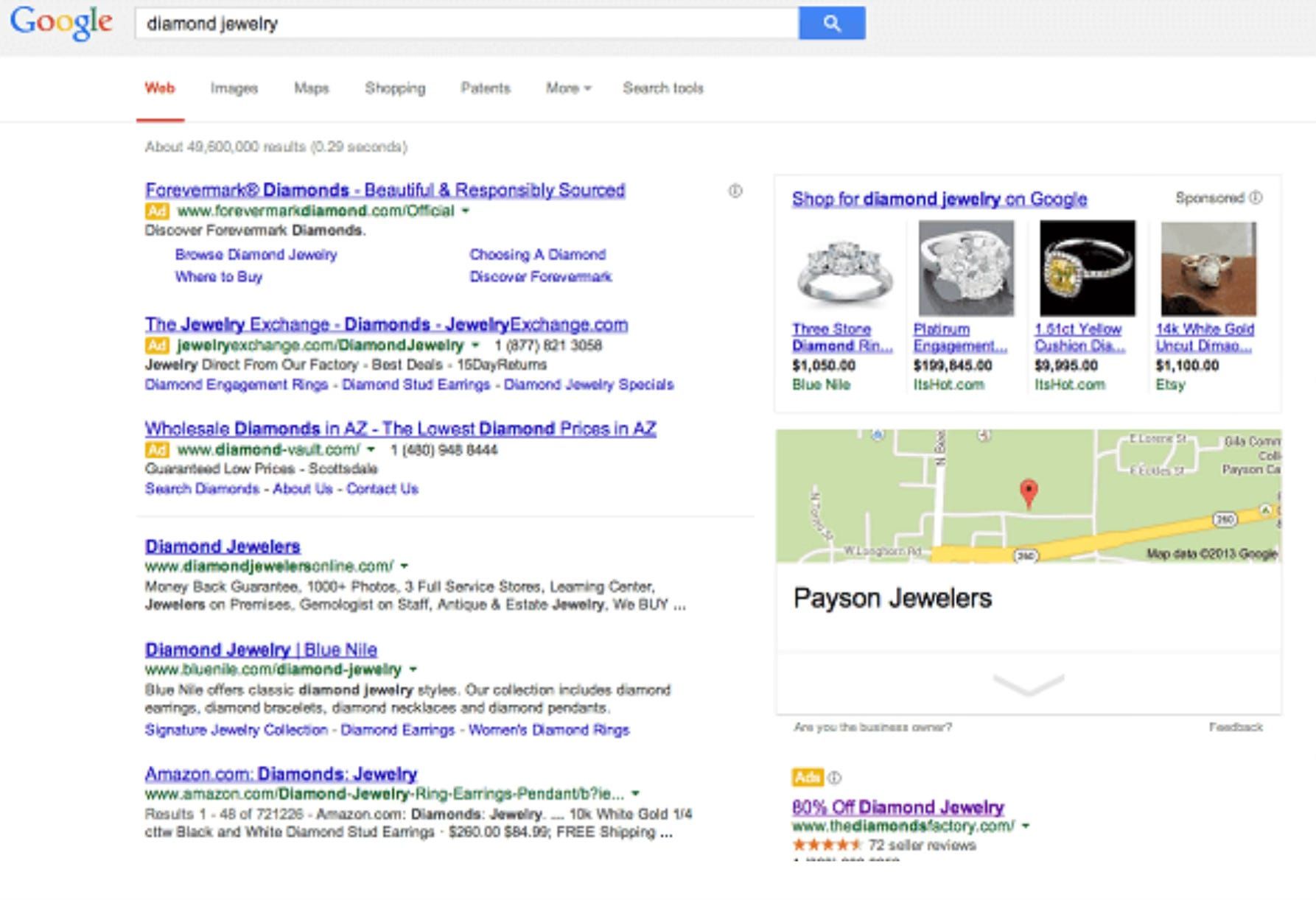
AI flipped that. Large language models don’t point at the web they absorb it, rephrase it, and hand the user a finished answer. Google is doing the same thing with AI Overviews and the newer AI Mode, which fully replaces the blue-link results page with an AI conversation.
The numbers are no longer theoretical:
- By mid-2025, roughly 58–65% of Google searches ended without a single click to any external website, according to Semrush and Similarweb clickstream data.
- For queries that triggered an AI Overview, organic click-through rates dropped 61% — from 1.76% to 0.61% — per Seer Interactive’s September 2025 analysis.
- In Google’s AI Mode, 93% of searches end without a click (Semrush, September 2025).
- Only 1% of users click the source citations inside an AI Overview (Pew Research, 2025).
Publishers felt it first. HubSpot lost 70–80% of its organic traffic. CNN dropped 27–38% year-over-year. News publishers globally saw a 33% decline in Google search traffic between November 2024 and November 2025.
If you’re running content marketing off the 2019 playbook, you’re not failing at SEO. You’re playing a game that no longer exists.
Why Users Switched So Fast (The Psychology)
The speed of this shift confuses people. Whole industries spent two decades training consumers to “just Google it.” How did AI retrain them in 18 months?
Because humans will always choose the lower-friction path to an answer. Always.
Google was always friction. You had to parse ten results, evaluate credibility, skim the page, dodge pop-ups, and piece together a conclusion. AI strips all of it out. You ask in plain language, the way you’d ask a friend, and a plain-language answer comes back. No evaluation. No scrolling. No judgment.
That last part matters more than people admit. A big reason ChatGPT grew so fast is that users feel comfortable asking it the things they’d be embarrassed to put into a public search bar. Medical questions, money questions, relationship questions, “am I crazy for thinking…” questions. The AI doesn’t blink. It just answers.
This creates a feedback loop. Ask → get a useful answer → dopamine hit → ask again. Within a few weeks, the habit is rewired. Google becomes the place you go for directions and showtimes. AI becomes the place you go for thinking.
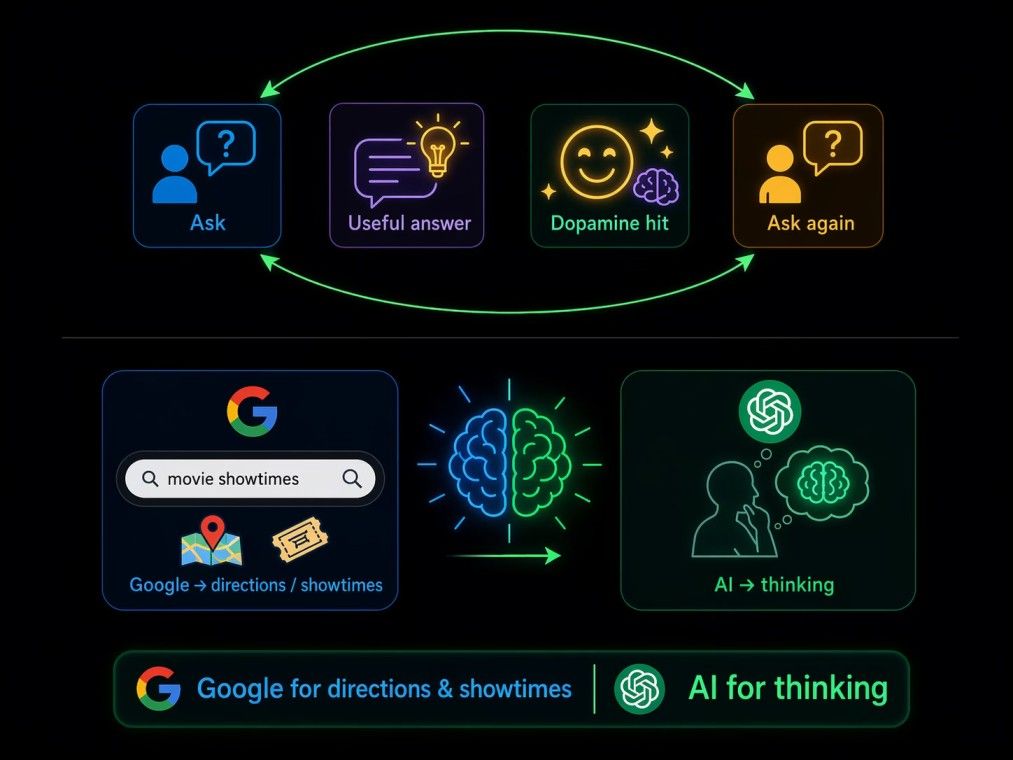
That’s not a trend. That’s a permanent behavior change.
How AI Actually Learned to Do This
Quick detour for the marketers in the room who want to know how this happened — without the engineering lecture.
Large language models like ChatGPT, Claude, and Gemini were trained on massive slices of the public internet. That includes websites, forums like Reddit, product reviews, academic papers, news articles, and importantly the patterns of what users searched for and what pages actually answered those searches well.
In other words: AI learned from the same web SEO taught us to rank on. It studied the top-ranking pages, the highest-engagement Reddit threads, the most-cited blog posts. It absorbed the collective answer to almost every question the internet had ever asked.
Then it was given a chat interface.
The irony is hard to miss. The web we spent 20 years optimizing became the training data for the system that’s now replacing it as the first stop for answers. Every blog post that ranked well taught the AI how to sound authoritative on that topic. Every “how to” guide contributed to a future AI Overview that would summarize it away.
You don’t have to love this. But you do have to accept it, because it’s the ground you’re building on now.
The Zero-Click Problem Isn’t Coming. It’s Already Here.
Here’s the part that most SEO conversations still soften.
The zero-click era isn’t a future scenario you should “start thinking about.” It’s the current reality for the majority of informational queries. Ahrefs data from late 2025 shows that 99.9% of informational keywords now trigger an AI Overview. If your content targets a how-to, a definition, a “best of” list, an explainer — anything informational — an AI is sitting between you and your reader by default.
Google itself is accelerating the shift. AI Overviews now reach 1.5 billion users monthly across 200+ countries. AI Mode, launched in March 2025, represents what Google’s leadership has publicly called the future of search.
And even when users do still click through, the click-through rate is collapsing. A lifestyle publisher the UK’s Professional Publishers Association tracked saw their CTR drop from 5.1% to 0.6% — a 88% decline — despite stable rankings. Gartner projects a 25% decline in traditional search traffic by the end of 2026, and many industries are already past that number.
If you’re a brand that treats organic traffic as your primary marketing channel, you’re watching the channel narrow in real time. The water isn’t gone yet. But the pipe is shrinking.
The SEO industry’s default response “publish more, rank higher, optimize for AI Overviews” is half an answer. Because being cited in an AI Overview sounds valuable until you remember that only 1% of users click the citations. Citation is visibility. Visibility is not traffic.
We need to rethink what content is actually for.
The Two-Job Content Strategy
Here’s the shift I want you to make.
Stop thinking about a piece of content as one thing that does one job. Start thinking about every piece you publish as having two distinct customers, with two distinct jobs to do.
Job 1: Feed the AI so you control what it says about you
The AI is now the first reader of your content. Not the human. The AI scans, indexes, and synthesizes your writing before a human ever sees it — and then it decides what to say to the human on your behalf.
That means your content has to be AI-legible.
- Use clear, structured answers. 40–60 word paragraphs that answer a question directly. Headings that mirror how real people phrase questions (”What is X?”, “How do I do Y?”).
- Add schema markup. FAQ schema, HowTo schema, Article schema. This is the metadata AI uses to understand what your page is and what each section means. It’s technical but cheap — any decent CMS plugin handles it.
- Publish original data. Surveys, benchmarks, proprietary research, case studies with specific numbers. AI prefers to cite sources that bring something new to the table rather than restate what every other page already says.
- Be directly quotable. Write in a way that a 60-word pull-quote from your article could stand alone as an answer. If your argument only makes sense after three paragraphs of setup, AI won’t cite it.
This is Job 1: you’re not writing for the reader yet. You’re writing for the model that stands between you and the reader. Your goal is to condition what the AI says when your name, your niche, or your topic comes up.
Job 2: Convert the human who still lands on your site
The humans who do click through in 2026 are different from the ones who clicked through in 2019. They’ve already read the AI’s summary. They didn’t need the basics. They came to you because they wanted something the AI couldn’t give them.
Your site has to be worth that journey.
- Have a point of view. AI is extraordinary at synthesizing consensus. It’s terrible at taking a side. Opinion, conviction, and disagreement are now the rarest commodities on the web — and the most valuable.
- Share lived experience. AI cannot have run the experiment, lost the client, shipped the product, or watched the trend play out over five years. Your first-hand stories are uncopyable.
- Build things AI can’t summarize. Interactive calculators, assessments, templates, diagnostic tools, communities, paid courses. Anything where the value requires the user to use it, not read about it.
- Capture the relationship. Email list, Substack subscription, community invite. Because even if the AI takes the next click, you still own the direct line.
Job 2 is where your brand actually lives. The AI fed them the facts. You give them the interpretation, the personality, and the reason to come back directly next time.
The Metric That Actually Matters Now
If you take one operational thing from this piece, it’s this: stop measuring success by clicks alone.
The new metrics are messier but truer:
- Share of voice in AI answers. When someone asks ChatGPT, Claude, or Perplexity about your topic, does your brand get mentioned? How often? In what position?
- Branded search volume. Are more people searching your name directly? That’s the signal that AI is introducing you to audiences who then come looking for you by name.
- Direct traffic quality. AI-referred visitors convert at roughly 23x the rate of traditional organic traffic, per Ahrefs data analyzed by Passionfruit. Fewer visitors, higher intent.
A 30% traffic decline doesn’t mean what it used to mean. If the 70% you kept converts 5x better, the business is fine. If you can’t tell the difference, your measurement stack is out of date.
You’re Probably Only Doing One Job
Most brands I look at are stuck doing one of the two jobs, not both.
The SEO-heavy ones are obsessed with Job 1. Clean structure, schema everywhere, perfectly optimized for the AI to chew on. But when a human actually lands on the page, they find a well-organized document with no soul — the same consensus answer the AI already gave them, just longer. No reason to stay, no reason to subscribe, no reason to remember the brand.
The brand-heavy ones are obsessed with Job 2. Great voice, strong opinions, genuinely interesting ideas. But the pages aren’t structured for AI to cite, schema is missing, and the writer buries the answer 400 words in. The AI skips them entirely, so the only humans reading are the ones already on the email list.
The brands that will compound over the next three years are the ones doing both — writing for the machine and the human in the same piece, without compromising either.
So here’s the honest question for your content right now: Which job is it doing well, and which is it failing?
Drop a reply and let me know. I read every one.
Iscriviti
test
Sources & further reading
If you want to go deeper on the data behind this piece:
- Semrush’s AI Overviews Study — 10M+ keywords analyzed, the most comprehensive public dataset on AI Overview behavior.
- Seer Interactive’s CTR Analysis — the 3,119-query study that produced the 61% CTR drop figure.
- The Digital Bloom’s 2025 Organic Traffic Crisis Report — publisher-level impact numbers (HubSpot, CNN, and more).
- Onely on Zero-Click to Zero-Search Discovery — the case for why AI-referred traffic converts at a premium.
- Superprompt’s Zero-Click Recovery Plan — November 2025 data + Gartner projections.
If you appreciate this work feel free to leave your thoughts and share it with other people that you think could benefit reading it.
About the author

Marco Cirillo
Senior SEO & GEO Manager
Turning complex SEO into predictable SaaS growth across Google and AI ecosystems. With 9+ years of experience in SEO, Growth, and AI Visibility Strategy, I help B2B SaaS companies transform their organic presence into a scalable, measurable growth engine.
 Marco Cirillo
Jun 2, 2026 / SEO-GEO News
Google 2026 Endgame: Consumer search behaviour has structurally changed, Google owns data proves it.
TL;DR Google published a year of AI Mode behavior data the same week as I/O 2026. The average AI Mode query is 3x longer than a traditional search query. Planning intent is growing 80% faster than overall query volume. Image searches are up 40%+ per month. Separately, an independent study of 500,000 prompts found AI Overviews appearing in 86% of searches, up from 57% twelve months ago. These are not predictions. They are measurements of how a billion people search right now. If your content strategy was built before this data, it’s optimizing for behavior that has already shifted.